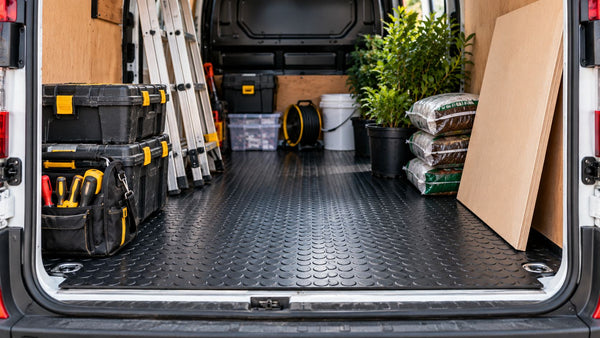
There is no single best finish in a coin vs checker vs ribbed flooring comparison. The right choice depends on where the floor will go, what will cross it and the specification of the product you buy. Pattern affects how the floor looks and where dirt may settle, but it cannot tell you on its own how well a floor will resist slips or support heavy equipment.
For a working van, start with the loads, muddy footwear and cleaning routine. For a campervan, you might place more weight on the visible finish and how the covering fits around irregular edges. In a workshop, consider both foot traffic and anything that will stand or roll across the floor. Once you know what the covering needs to do, compare the three finishes.
Surface Pattern

Coin flooring has raised circular details, checker plate has a repeating raised bar design, and ribbed flooring has parallel ridges. Those are useful visual distinctions, but each product also has its own material and size specification.
|
Finish |
What You Will See |
What to Consider |
|
Coin |
A repeated field of raised circles |
Whether the scale of the circles suits the area and how you will clean around them |
|
5 Bar Checker |
Groups of raised bars set in a repeating pattern |
How prominent the pattern looks across the full floor |
|
Ribbed |
Ridges running in one direction |
Which way the lines will run once the floor is cut and fitted |
Tuda’s coin rubber flooring is listed with 3 mm and 5 mm options. Its linked checker plate rubber flooring is specifically a 5 bar checker product, while its ribbed rubber flooring has a linear finish. The checker and ribbed pages describe 3 mm products. Check the selected variant rather than assuming that every flooring product with the same pattern has the same thickness or composition.
A small product image can make all three patterns appear similar in scale. If the floor will remain visible across a large van or workshop, compare samples side by side and view each one from standing height as well as close up.
Grip and Slip Resistance
You cannot identify the grippiest floor from its pattern name. Traction depends on the particular product, the footwear used and whether the surface is dry, wet or contaminated with dirt or oil.
Imagine climbing into a van with wet boots after working outdoors. A raised pattern is visible, but its appearance is not a measured slip rating for those conditions. The same floor may behave differently when grit is left on it or a spill has not been cleaned up.
If slip resistance is a deciding requirement, ask for test evidence for the exact product and check that the test conditions are relevant to its intended use. Keep the floor clean and address spills promptly, whichever finish you choose.
Ease of Cleaning
The easiest finish to maintain depends on the mess you need to remove and the cleaning method recommended for the product. Think about fine dust, larger grit and dried mud separately.
|
Finish |
Cleaning Consideration |
|
Coin |
Check how easily dust and grit can be removed from between the raised circles. |
|
5 Bar Checker |
Look at the spaces around the raised bars, especially if muddy grit is common. |
|
Ribbed |
Check whether fine debris settles between the ridges and how you would remove it. |
For example, a tradesperson sweeping sawdust from a van each week has a different task from someone removing wet mud after every shift. Look closely at a sample with your usual cleaning routine in mind. Pay attention to edges, joins and the rear threshold, where debris may be harder to reach regardless of the pattern.
Before using a cleaner, brush or solvent, check the care guidance for the specific material. Tuda’s wider collection includes products described as rubber and products described as rubber/PVC, so one cleaning product should not automatically be assumed suitable for the entire range.
Water and Dirt Management
A surface pattern can influence where water and dirt sit, but it does not make a fitted floor waterproof or self-draining. Joins, cut edges and the condition of the floor beneath it matter just as much.
Consider a work van with rainwater entering at the rear doors. Inspect where the water lands, whether the vehicle floor slopes and whether it can reach an exposed edge or join. Rib direction may affect where moisture is visible or collects, but it is not a reason to assume water will safely drain away. Coin and checker patterns likewise do not prevent a spill from reaching the floor beneath the covering.
Remove standing water and debris promptly. If frequent wet use is expected, ask Tuda for fitting guidance on edges and joins and check the condition of the underlying floor before installation. The aim is to choose a covering and fitting approach that suit the whole area, rather than relying on the surface pattern alone.
Comfort Underfoot

Comfort depends on the full floor construction, your footwear and how long you stand or kneel there. A raised coin, checker or ribbed texture cannot establish which product offers the most cushioning.
If you stand at a workshop bench for hours, consider the supporting floor and whether a mat designed for that workstation is needed. If you kneel frequently in a van, a sample can help you judge how a pattern feels against your knees or through clothing. It will not demonstrate how comfortable the installed floor will be throughout a working day.
Check the thickness of the variant you are considering, but avoid using thickness alone as proof of an ergonomic benefit. The underlying surface and the way the floor is fitted will also affect the result.
Durability and Wear
Pattern does not establish lifespan. Everyday wear depends on the material, thickness, fitting and what happens on the floor.
Look at the places that will receive repeated use: the rear doors of a van, a workshop entrance or the path between storage and a workbench. Loading equipment cases over the same threshold every day may wear the raised surface differently from ordinary foot traffic. Dragging an item can also damage a covering even if that product copes well with people walking on it.
Check that the chosen product is intended for the space and inspect its edges after fitting. If wear occurs at a doorway, examine both the covering and the floor beneath it before deciding what needs repair. A worn pattern and a damaged supporting floor are different problems; replacing the covering will not fix the latter.
Suitability for Heavy Loads
Choose flooring for heavy equipment by checking the exact product and supporting floor, not by choosing the boldest-looking pattern. The area touching the floor is often as important as the equipment’s total weight.
A heavy toolbox on small castors puts weight through narrow contact points as it crosses the same route repeatedly. Fixed machinery on small feet creates a different demand from a broad cabinet that remains in place. Before selecting a covering, establish:
-
What will sit or move on the floor, including its weight and contact points.
-
Whether small wheels, feet or sharp edges could mark or damage the surface.
-
What supports the covering and whether that floor is suitable for the load.
-
Whether Tuda has product guidance or load data for the proposed use.
The covering may serve as a wear surface, but it should not be treated as a structural floor or a rated load-spreading system without evidence. If heavy machinery or repeated wheel traffic is central to the job, confirm suitability before ordering.
Appearance
Pattern is a valid reason to prefer one suitable product over another. Once you have checked the practical requirements, choose the finish you want to see across the space.
Coin gives a regular field of circles. Tuda’s linked 5 bar checker has a more angular repeated design. Ribbed flooring creates lines whose direction will be especially noticeable over a larger area. A campervan owner choosing a visible interior floor may judge that effect differently from someone fitting a work van primarily for daily use.
View samples in the space if possible. Compare them in daylight and under the lighting normally used there, and set them beside nearby trim or wall lining. A tightly cropped online photograph is useful for identifying a pattern, but it may not show how prominent that pattern will look once several metres are fitted. Check the product page for the currently available colour and variant before making the final choice.
Best Uses for Each Finish
Each finish is worth considering where the particular product meets the needs of the space. This table gives you a starting point for a shortlist, followed by the check that matters before purchase.
|
Your Priority |
Finish to Consider |
Check Before Ordering |
|
A regular, circular pattern across a visible van floor |
Coin |
The chosen thickness, material, width and suitability for your van use |
|
An angular, prominent surface design |
5 bar checker |
The exact 5 bar product specification and how the raised pattern looks at full scale |
|
A linear appearance with a clear pattern direction |
Ribbed |
The direction of fitting, dimensions and suitability for your cleaning routine |
|
Frequent movement of equipment |
Any finish that meets the requirement |
Product guidance for the equipment, wheels or feet, and the supporting floor |
Tuda lists the linked flooring products for van floors and other practical spaces, but that broad list does not settle a specialist load, chemical exposure or slip requirement. Compare the wider rubber flooring range if width, thickness or material is more important to your project than the first pattern you liked. The collection includes rubber products alongside products described as rubber/PVC, including different widths and finishes.
Which Rubber Flooring Finish Should You Choose?
Choose a product that meets the demands of your space, then use the pattern to decide between the suitable options. For many buyers, that means narrowing the choice in five steps:
-
Describe the use. Note the footwear, foot traffic, spills, cleaning routine and anything that will be moved or stored on the floor.
-
Check the product. Confirm the material, thickness, roll width and any performance evidence needed for your application.
-
Measure the area. Include the widest points, wheel arches, door openings and other irregular edges. Plan where any joins would fall before choosing a width and length.
-
Check the fitting guidance. Consider the condition of the supporting floor and how edges or joins should be finished. Follow the instructions for the selected product and fitting materials.
-
Compare the finishes in person. If two products meet your requirements, inspect rubber flooring samples to judge pattern scale, colour and surface feel. A sample cannot replace technical evidence for grip or heavy loads.
For a van floor, the best result comes from matching the product to the job and measuring carefully before you cut. Coin, 5 bar checker and ribbed finishes then give you three distinct looks from which to choose.